
Although most players in the hostel industry are for-profit and care about their finances as much as any other businesses, we can choose to see it as an industry that resembles a social institution in a way. In doing so, the idea of social responsibility gets entangled with budget tourism, extending and transforming into something much broader. These hostels have morphed volunteerism into voluntourism, where, through the assistance of these hostels, travelers become immersed in local communities with the ability to support them through physical work or donations. The list of interesting social projects that some hostels choose to incorporate into their work is, honestly, infinite. Hence, HostelTrends has decided to look into several of them and ask the hostel managers themselves to share their experiences that may be applicable to different causes.
To begin our series of articles on this engaging topic, I talked to Fabiana, the manager of El Misti Salvador, one of El Misti chain hostels in Brazil, about the discount program they offer to their more active guests.
How to Arrive at the Best Idea
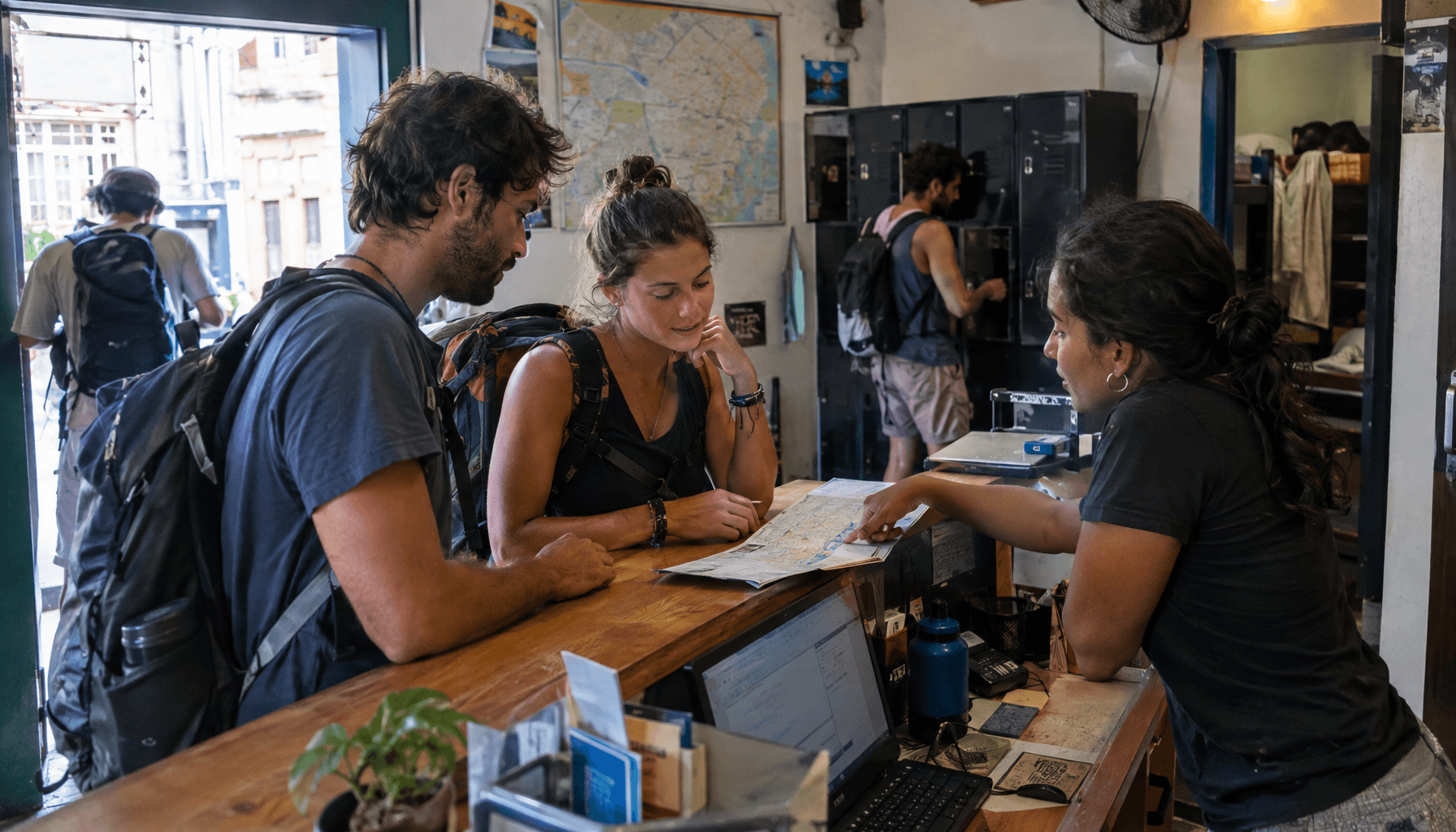
Essentially, the El Misti hostel chain offers up to five consecutive nights in each of their hostels for free for guests traveling the country (or the continent) by bike, and they provide a 50 percent discount for five nights for surfers and climbers. These programs are called, respectively, Bikepackers, Surfpackers, and Climbpackers. “How did this all start, and what should other hostels take into consideration if they are thinking about promoting some good cause?” I asked Fabiana as we began our chat at El Misti Salvador under several ceiling fans. Apparently, besides the owner of the El Misti chain being a big cyclist, Fabiana told me that this idea developed very organically, as El Misti would receive many bikers in their Rio de Janeiro hostel; given that Rio itself has a cycling marathon and many bikers. In Salvador, for example, there is a surfers’ festival, which sparked the idea of the Surfpackers program. Most of El Misti’s hostels attract guests who lead pretty active lives; therefore, Fabiana’s advice is to observe current trends in your location and see what project naturally emerges from your current situation. Basically, instead of trying to push a new trend, capitalizing on what is already happening might be the smartest way to go. Even their hostel staff is passionate about sports, Fabiana explained, which made the implementation of the programs easier.
Of course, I must add that at least three problems might arise if you take this approach. First, precisely because you are adapting to the present situation, you might find the market already saturated with similar projects, which could make your branding more difficult. Second, despite the fact that pushing a new trend might seem risky, noticing an untapped niche could bring even more benefits in the long term. Third, some causes that you may want to consider promoting require deep insights into your local community and not just your guests (for instance, maybe there is a demand for volunteer English teachers, a need for supporting local infrastructure projects, etc.), so spotting a niche for your idea might require more research. Hence, El Misti’s case is an interesting example of promoting a good cause, yet it is not intended to embody some magical universal formula.
Marketing Matters
Although El Misti could not identify if they have received a significantly larger number of travelers just because of these programs, Fabiana told me that these programs create and, to an extent, rely on two different marketing outlets. The first is word-of-mouth: travelers who take advantage of El Misti’s offers are expected to share their experiences with other fellow bikers, surfers, and climbers encountered throughout their travels. This is assumed to be most efficient among cyclists, since some of them travel long distances using the same routes. The second outlet is travelers’ blogs: only travelers who are documenting their trips can participate in the discount programs, so El Misti hopes that by being mentioned in some of them, they can attract more travelers of the same type. “It’s not just about marketing; it’s about branding,” Fabiana told me. By introducing programs for more physically active guests, the chain is, in a way, reinforcing and forming its image, also placing itself in a more narrow (yet not necessarily exclusive and limiting) niche. Thus, marketing and branding go hand in hand here.
Further Advice
I asked Fabiana for some last general advice El Misti could give to other hostels considering implementing some social projects. “After planning everything, make sure communication is efficient,” Fabiana said and then explained that, in the specific case of their programs, clear communication has been crucial. For example, guests who would like to use El Misti’s offers need to book in advance. They also have to have proper documentation (e.g., a blog) of their travels, and they can only use this offer during the low season. Basically, it is not enough for some backpacker on a bike to show up one evening at El Misti and ask for a free bed; it needs to be a bit more formal and premeditated.
To conduct a basic cost-benefit analysis was another tip Fabiana shared with me. For example, for programs like Bikepackers, Surfpackers, and Climbpackers, you have to take into consideration your bed capacity and see how this deal would work in both low and high seasons. Can you afford to offer this deal during the low season? What if travelers come in large groups? Also, some programs/projects would work better in chain hostels, of course, than they would in single hostels, etc.
To sum up, El Misti’s programs are still relatively new, and only time will tell how successful they are. At the same time, there are plenty of lessons that this example can teach other hostels considering broadening their scope of work.